


Improving Mobile Signal Through Glass: Introducing WAVETHRU


At PropTech Connect Europe 2026, INCO Robotics showcased WAVETHRU technology, which enables mobile communication inside buildings through glazing.
We are proud to be partners with AGC Glass Europe, one of the world’s leaders in glass technology. AGC developed the WAVETHRU technology and the specialist robot used to carry out the treatment.

The robot itself was also at PropTech Connect. Unfortunately, due to health and safety restrictions, we couldn't bring it onto the Innovation Stage, but visitors were able to see it in action on the INCO Robotics stand.
So, what is the problem that WAVETHRU is solving?

We’ve all experienced it. You walk into a building and suddenly your mobile phone stops working. Calls drop, reception disappears, or even something as simple as receiving a two-factor authentication code becomes difficult. Part of the reason can be the façade of the building.
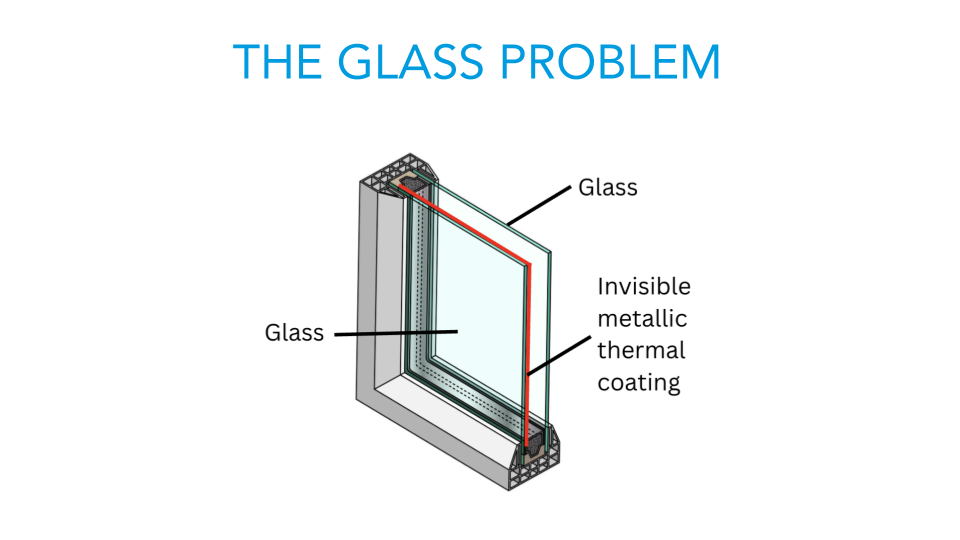
Modern building façades often incorporate a significant amount of high-performance glass. Within that glass are specialist coatings, and those coatings contain metal.
The metal helps the glass achieve its required thermal performance, but it can also prevent mobile radio frequencies from transmitting effectively through the glazing.
So AGC considered the problem from a different perspective:
What if we could make glass friendly to radio signals?

In other words, rather than trying to compensate for the problem once you are inside the building, how could we allow the mobile frequencies that are already outside to get through the glass in the first place?
The answer was WAVETHRU.
AGC developed a specialist robot that uses a laser to create microscopic etching within the metallic coating of the glass.
The treatment doesn't require the glass to be replaced and does not affect its thermal properties. Instead, it alters the coating in a way that allows mobile frequencies to pass through the glazing.

For the property sector, this provides a very different way of approaching poor indoor mobile reception.
If tenants, residents or guests are struggling to use their mobile phones inside a building, the traditional response may be to install more complicated active systems, such as DAS or small cells.
WAVETHRU tackles the problem at the building envelope instead. By treating the glass that is preventing the signal from entering, mobile reception can be improved to the point where, for example, a phone that previously couldn't make a call can make one.

How does the treatment work?
The process itself is remarkably clean and simple.
First, we come into the building and take readings. We check the glass and establish what is required. The robot is then positioned against the glazing, automatically detects the different elements within the glass and invisibly laser etches the coating.
Depending on the size of the window, an individual panel can typically be completed in less than ten minutes. Once that window is finished, the robot simply moves on to the next.

A treatment that lasts for the lifetime of the glass
There are a number of benefits to treating the glazing in this way, rather than introducing additional active infrastructure into the building.

One of the most important is that this is a one-time treatment.
Once the glass has been treated, the solution lasts for the lifetime of that glass. There isn't an active system that then needs to be continually powered, maintained or licensed.
Sustainable and cost effective
When WAVETHRU is compared with a traditional DAS system, the differences become particularly clear.
There are potential savings from both a capital and operational expenditure perspective, but also from a sustainability perspective.
WAVETHRU does not require ongoing electricity, licensing or the running costs associated with an active DAS or small-cell solution. Instead, the glass itself has been treated to allow the signal through.

How we discovered WAVETHRU
Our own introduction to WAVETHRU came about almost by accident.
INCO Robotics' sister company, Channel Serve Limited, specialises in active IT and connectivity solutions.
The Channel Serve team was working at a property here in London where a client was having difficulty receiving mobile phone signal inside his apartment. We were there trying to help with his Wi-Fi at the same time that the WAVETHRU team had been brought in to treat the windows.
Over the course of the day, we realised something had changed. The mobile phones were working. Before the treatment, making and receiving calls inside the apartment had been a problem. After the windows had been treated, calls could be made and received.
So naturally, the question was:
What's happened? - The answer was the robot.
The WAVETHRU robot had treated the windows and, in a real-world situation, we had watched the mobile phone problem disappear over the course of just a few hours.
That was our introduction to the technology - seeing it actually work.
It's important to understand what WAVETHRU is and isn't doing
One of the questions we were asked at PropTech Connect was whether WAVETHRU is somehow creating or amplifying the mobile signal.
It isn't.
If 4G or 5G signal is available outside the building, WAVETHRU allows that existing signal to pass through the treated glazing more effectively.
It's not amplifying the signal and it's not changing it. It's simply allowing you to receive inside the building the signal that is already available outside.
Nor is anything electronic being added to the glass. The laser simply creates microscopic etching within the existing metallic coating. Once the treatment has been completed, the robot moves away and there is no additional WAVETHRU equipment attached to the window.
Bringing WAVETHRU to the UK
Having seen the technology working first-hand, we are now working with AGC to bring WAVETHRU to the UK property market through INCO Robotics.
The technology provides a completely different way of looking at one of the most frustrating problems within modern buildings.
Instead of immediately asking:
“What equipment do we need to install inside the building to improve mobile reception?”
we can now also ask:
“What is preventing the mobile signal outside from getting into the building?”
If the answer is the glazing, the solution could be as simple as treating the glass.
We are currently looking for locations in London for further trials and case studies and would particularly like to hear from property owners and operators experiencing poor indoor mobile reception.
Sometimes, better connectivity doesn't require adding more technology to a building. It simply requires removing the barrier that's stopping the signal from getting in.


Comments